Is SEO Worth It for a Small Business?
SEO is worth doing for most small businesses, but it is not automatically worth paying an agency for. Start with the free basics: make your website and local profiles clear, accurate and useful, then measure enquiries, calls and bookings. Pay for specialist help only when you have technical problems, strong competition, several locations or no time to do the work yourself.
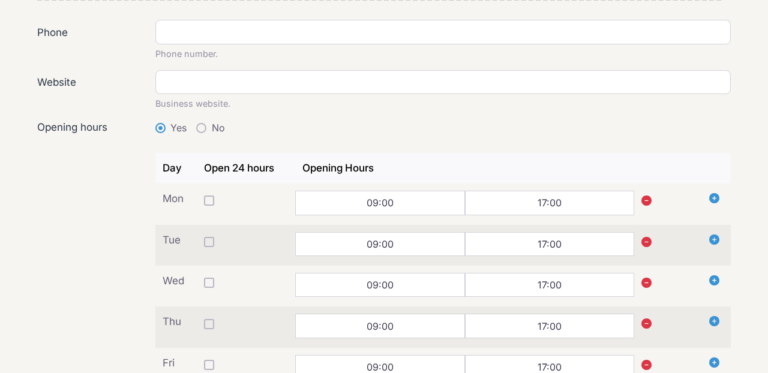
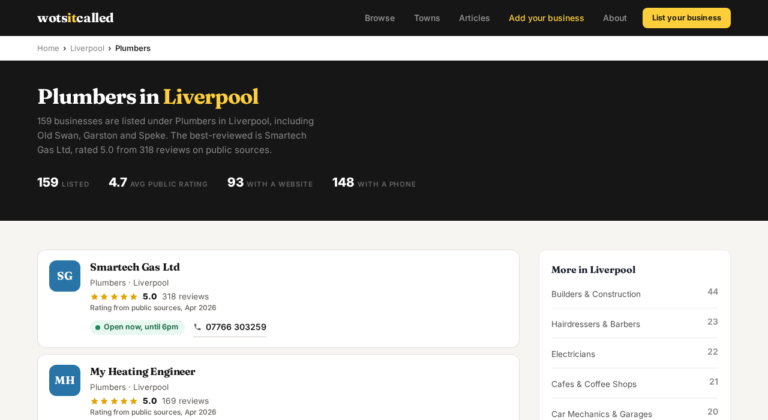
If you have just listed your business on WotsItCalled, think of SEO as making it easier for customers and search engines to understand what you do, where you work and how to contact you. A listing can be one useful free source of visibility, alongside your website and other local profiles.
SEO in one sentence
SEO means improving a website so search engines can understand it and people can find and use it. Google describes SEO as helping search engines understand your content and helping users decide whether to visit your site. It is not a secret method for automatically reaching position one.
For a small business, practical SEO usually means having clear service pages, accurate contact details, useful answers to customer questions and complete local profiles. It also means checking that search engines can access the pages you want customers to find.
Google’s SEO Starter Guide explains the basic principles. Its guidance is useful because it focuses on helping people, rather than promising a particular ranking.
The three steps: crawling, indexing and ranking
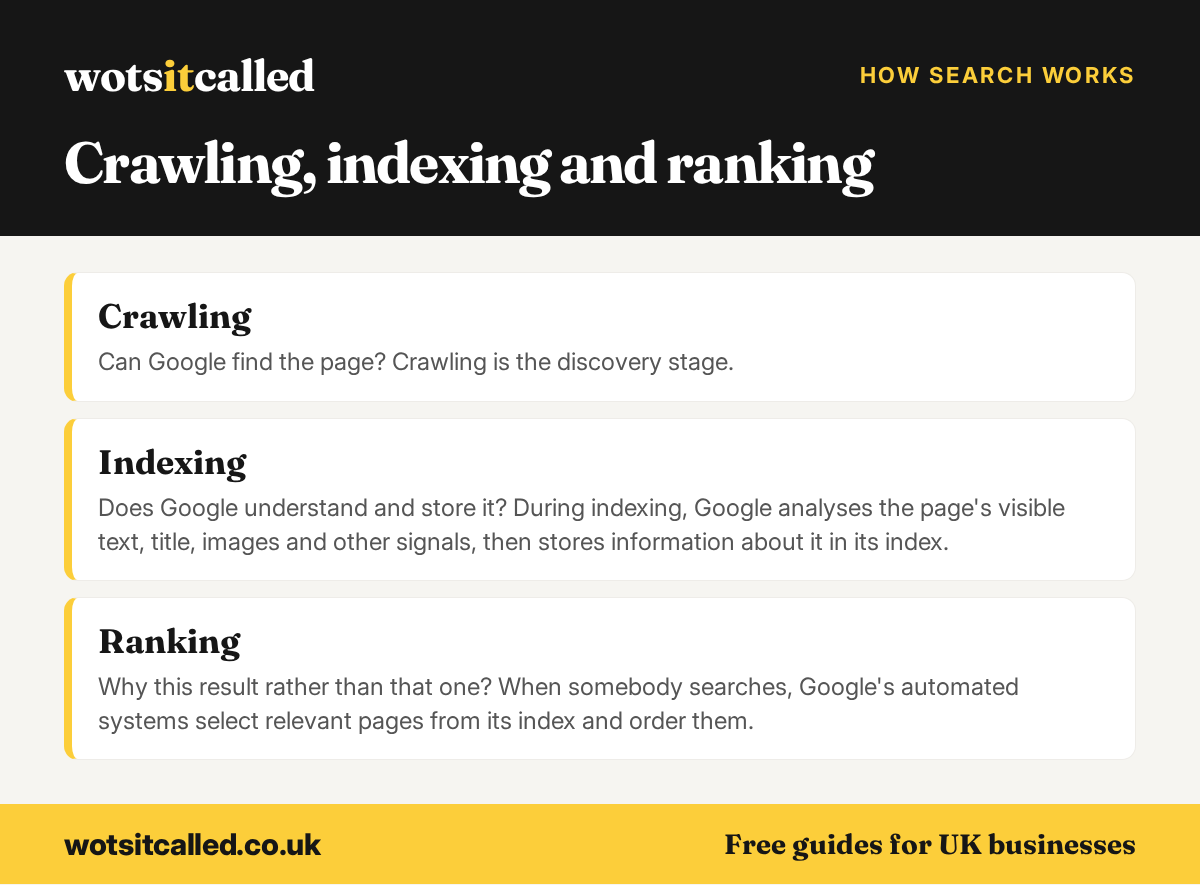
Crawling – can Google find the page?
Crawling is the discovery stage. Automated crawlers find pages through links, sitemaps and Google’s previous knowledge of the web, then download the page and its resources.
Google may struggle to crawl a page if the server returns errors, the network is unavailable, important content is blocked by robots.txt or the page relies on JavaScript that cannot be rendered properly. A sitemap can help Google discover new or updated URLs, but it does not guarantee indexing or improve ranking by itself.
Use the URL Inspection tool to check whether Google knows about an important page, whether it could crawl it and which canonical URL it selected. Requesting indexing puts the page in a queue. It does not guarantee that the page will be included.
Indexing – does Google understand and store it?
During indexing, Google analyses the page’s visible text, title, images and other signals, then stores information about it in its index. Google may choose one canonical version where several pages contain duplicate or very similar content.
A page can be crawled but not indexed. Common issues include a noindex instruction, low-quality or inaccessible content, duplicate pages and a site structure that makes important information difficult to understand.
Indexing is not the same as appearing for every search. It means Google has stored the page and may show it. The Search Console reports and URL Inspection tool can help you find unexpected exclusions.
Ranking – why this result rather than that one?
When somebody searches, Google’s automated systems select relevant pages from its index and order them. Ranking uses many signals, and relevance depends on the query and context, including language, location and device. A search for a bicycle repair shop can produce different results in different towns.
Organic results are unpaid web results. They are different from adverts, even though both can appear on the same results page. Google says it does not accept payment to crawl a site more frequently or rank pages higher, and it does not guarantee that a page will be crawled, indexed or shown.
Do not judge progress only by checking one ranking manually. Search Console’s Performance report shows impressions, clicks and click-through rate, and can be filtered by query and page.
Local SEO versus organic SEO
Local SEO
Local SEO matters when you serve a town, neighbourhood or defined service area. Google says local results are mainly based on relevance, distance and prominence.
- Relevance means how well the business profile matches the search.
- Distance means how far the business is from the searcher or the relevant location.
- Prominence reflects how well-known the business appears to be.
Complete business information helps Google understand relevance. Google also says prominence can be influenced by factors such as links from other websites and the number and quality of reviews. A local search may produce a map result, a Business Profile, local organic pages or all three.
If you have a physical location customers can visit or you travel to customers, you can generally create a Google Business Profile, subject to Google’s eligibility rules. Keep the category, opening hours, service area, telephone number, website, photos and services accurate.
Organic SEO
Organic SEO is the work you do on your website to help useful pages appear in unpaid search results. A small business might create one clear page for each important service, explain which locations it serves and answer questions customers ask before contacting it.
Useful pages are more valuable than repeating a town name in every paragraph. Google recommends helpful, reliable, people-first content rather than content written only to manipulate rankings.
Other free local listings
Google is not the only place where customers look. Apple Business Connect is a free service for managing information shown in Apple Maps, Wallet, Siri and related Apple experiences. Accurate information across your website, Google Business Profile, Apple Business Connect and your own WotsItCalled listing gives customers fewer conflicting details to deal with.
What you can do yourself for free
Set up Search Console
Verify your website in Google Search Console. Inspect the homepage and your key service pages, review the Page indexing report and check which searches, pages, impressions and clicks are being recorded. If your site has multiple indexable pages, check the Sitemaps report too.
This gives you evidence about whether Google can access your pages and whether people are finding them. It is more useful than paying someone to send a monthly screenshot of a single ranking.
Improve titles and pages
Give each important page a concise title that describes what the page is actually about. A practical pattern is:
Service + location | Business name
For example: Emergency Boiler Repair in York | Smith Heating. This format is a useful starting point, not a guarantee of a ranking.
Write around real customer needs. Explain whether you serve a particular area, what the service includes, how long it normally takes, what preparation is needed and what happens if something goes wrong.
Improve mobile usability and speed
Open your website on a phone. Check that the text is readable without zooming, buttons and telephone numbers are easy to tap, and important information is visible without fighting through pop-ups.
- Use HTTPS.
- Compress oversized images.
- Remove unnecessary scripts and autoplay video.
- Reduce intrusive pop-ups, especially on mobile.
- Review the Core Web Vitals report in Search Console or use PageSpeed Insights.
Google recommends pages that display well on mobile and provide a good overall page experience. Core Web Vitals are used by Google’s ranking systems, but a perfect technical score does not guarantee a top ranking.
Complete profiles and request honest reviews
Keep your Google Business Profile complete and current. Ask genuine customers for honest reviews, but do not offer discounts, gifts or other incentives in exchange for reviews, changes or removals. Do not ask only customers who are likely to leave a positive review.
Google prohibits incentivised reviews and selective solicitation. The CMA also says that fake reviews and certain misleading review practices are prohibited under UK consumer law provisions applying from 6 April 2025.
Is paying for SEO worth it?
When DIY is enough
Start yourself when you have one location, a small website, a modest service area and time to update pages and profiles. Search Console, a complete Business Profile, clear page titles, useful service content and accurate local listings can take you a long way.
When specialist help is sensible
Specialist help may make sense when your site has technical problems, you are planning a redesign or migration, you serve several locations, you operate in a competitive market or you do not have time to do the work properly.
A one-off audit or fixed project can be easier to assess than an open-ended retainer. Ask exactly what will be changed, which pages will be created or improved, who owns the accounts and how success will be measured.
What UK pricing can and cannot tell you
There is no authoritative UK-wide price list. Cost depends on competition, location, website condition, number of services and whether the provider writes content, makes technical changes, manages local profiles or carries out legitimate publicity.
- An international Ahrefs survey of 439 SEO providers (last updated August 2024) reported an average local SEO price of $1,557 per month, with 42% charging $250 to $1,000 per month for small-business SEO. This is not UK-specific data.
- A Government Digital Marketplace supplier listing showed SEO projects at £3,000 to £7,500 per unit, covering a broader service scope than a normal local package.
A monthly retainer is not automatically bad. It is justified only when there is continuing work such as content, technical improvements, local profile management, legitimate publicity, measurement and testing. The question is not whether SEO has a monthly price. It is whether the work is clear and likely to produce enough customer value to justify that price.
Red flags
- “We guarantee position one.”
- “We have a special relationship with Google.”
- “Pay us and Google will index you faster.”
- “You will get thousands of backlinks every month.”
- “We can hide your business from negative reviews.”
- The agency wants ownership of your domain, Google Business Profile or Search Console property.
- The reports show rankings but not pages created, fixes made, enquiries, calls or bookings.
- The proposal uses the same pages and links for every local business.
- You must sign a long contract before seeing a clear plan.
Google says it cannot guarantee crawling, indexing or ranking, and does not accept payment to rank pages higher. Buying links or arranging links primarily to manipulate rankings can result in Google treating those links as spam or taking action against a site.
Fake reviews can breach platform policies and UK consumer law. Google may remove reviews, restrict new reviews, unpublish existing reviews or display a warning on a Business Profile.
SEO in the AI-search era
Google’s AI Overviews and AI Mode use core Search systems and content from Google’s index. Google says normal SEO best practice remains relevant and that there are no additional technical requirements or special optimisations needed to appear.
AI features may change the journey from “search result, then click” to “summary, selected sources, then business action”. The effect on traffic and conversions will vary by query and industry, and Google does not promise more visits.
Bing’s AI Performance report measures when pages are cited in AI-generated answers across Microsoft Copilot, Bing AI summaries and selected partner experiences. Bing says a citation is not the same as a click or engagement.
The practical response is ordinary good marketing:
- Keep your business name, services, locations, opening times and contact details consistent.
- Publish direct answers to genuine customer questions.
- Show evidence such as real photographs, qualifications, prices or price ranges where appropriate, case studies and genuine reviews.
- Keep important facts current and make pages easy for people and machines to interpret.
- Track enquiries and calls, not just AI mentions.
Common myths
- “SEO means putting keywords everywhere.” Google recommends useful, people-first content and warns against writing solely for search engines.
- “Paying Google gets you organic rankings.” Google says it does not accept payment to rank pages higher.
- “Submitting a sitemap guarantees indexing.” A sitemap helps Google discover URLs but does not guarantee indexing or ranking.
- “If a page is indexed, it must rank.” Indexing only means Google has stored the page and may show it. Ranking depends on the query and many systems.
- “A perfect PageSpeed score guarantees position one.” Good page experience and Core Web Vitals do not guarantee a top ranking.
- “Local SEO is just adding the town name to every page.” Local results use relevance, distance and prominence. Repetitive location text is not a substitute for accurate information and useful pages.
- “More reviews always means higher rankings.” Reviews can help prominence, but Google does not publish a simple review-count formula or guarantee a ranking.
- “AI search needs a separate secret optimisation system.” Google says its AI features use core Search systems and require no special optimisation beyond normal SEO best practice.
- “Being cited by an AI answer means you received a customer.” Bing explicitly separates AI citations from clicks and engagement.
A practical first-month plan
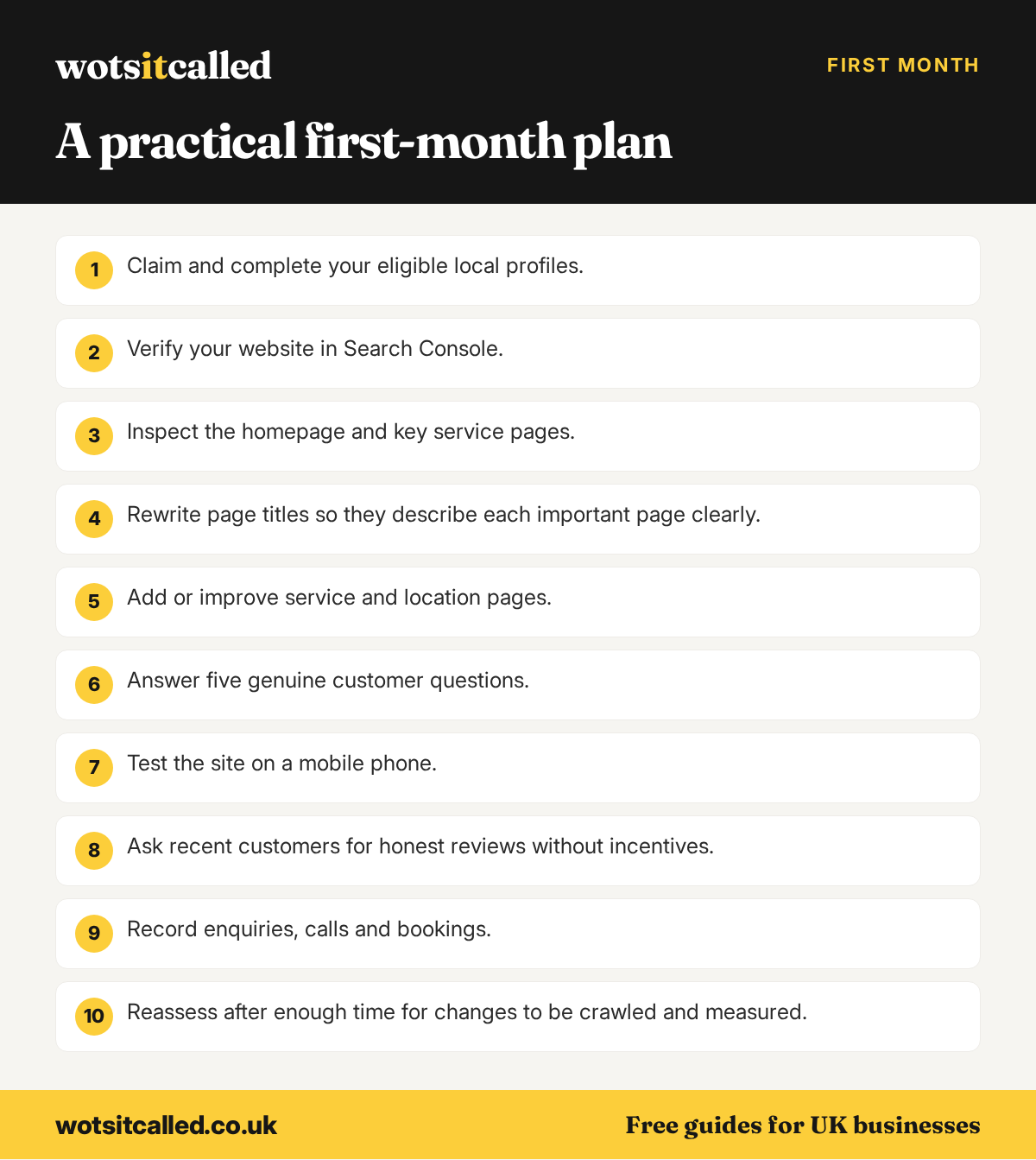
- Claim and complete your eligible local profiles.
- Verify your website in Search Console.
- Inspect the homepage and key service pages.
- Rewrite page titles so they describe each important page clearly.
- Add or improve service and location pages.
- Answer five genuine customer questions.
- Test the site on a mobile phone.
- Ask recent customers for honest reviews without incentives.
- Record enquiries, calls and bookings.
- Reassess after enough time for changes to be crawled and measured. Google says changes can take from hours to several months, with no guaranteed timetable.
Quick checklist
- Check that your website works on a phone.
- Make the main service and location obvious on the homepage.
- Give each important page a clear, descriptive title.
- Verify Search Console and inspect key URLs.
- Complete your Google Business Profile if eligible.
- Check that your name, phone number, website and opening hours match across profiles.
- Ask genuine customers for honest reviews, without rewards or five-star wording.
- Write down calls, forms, bookings and sales so you can judge whether the work is useful.
- Reject guaranteed rankings, paid links and agencies that want to own your accounts.
- Use WotsItCalled as one of the free places where customers can find accurate information about your business.
SEO is usually worth doing when it helps the right customers understand and choose your business. Whether it is worth paying for depends on your customer value, competition, website, available time and the actual work a provider will deliver. There is no universal answer, so start with the free foundations and measure what turns visibility into enquiries.
Facts in this guide were checked against the sources linked on 7 October 2026. Platform rules and prices change, so check the linked page before you rely on a detail.
More free guides for business owners
- How to Make the Most of Your WotsItCalled Listing
- How to Get Found on Google as a Small UK Business
- Free Business Listing Sites for UK Small Businesses in 2026
- How to Optimise Your Business Listing